Black Label Movement

nav menu

Press

Dance Magazine

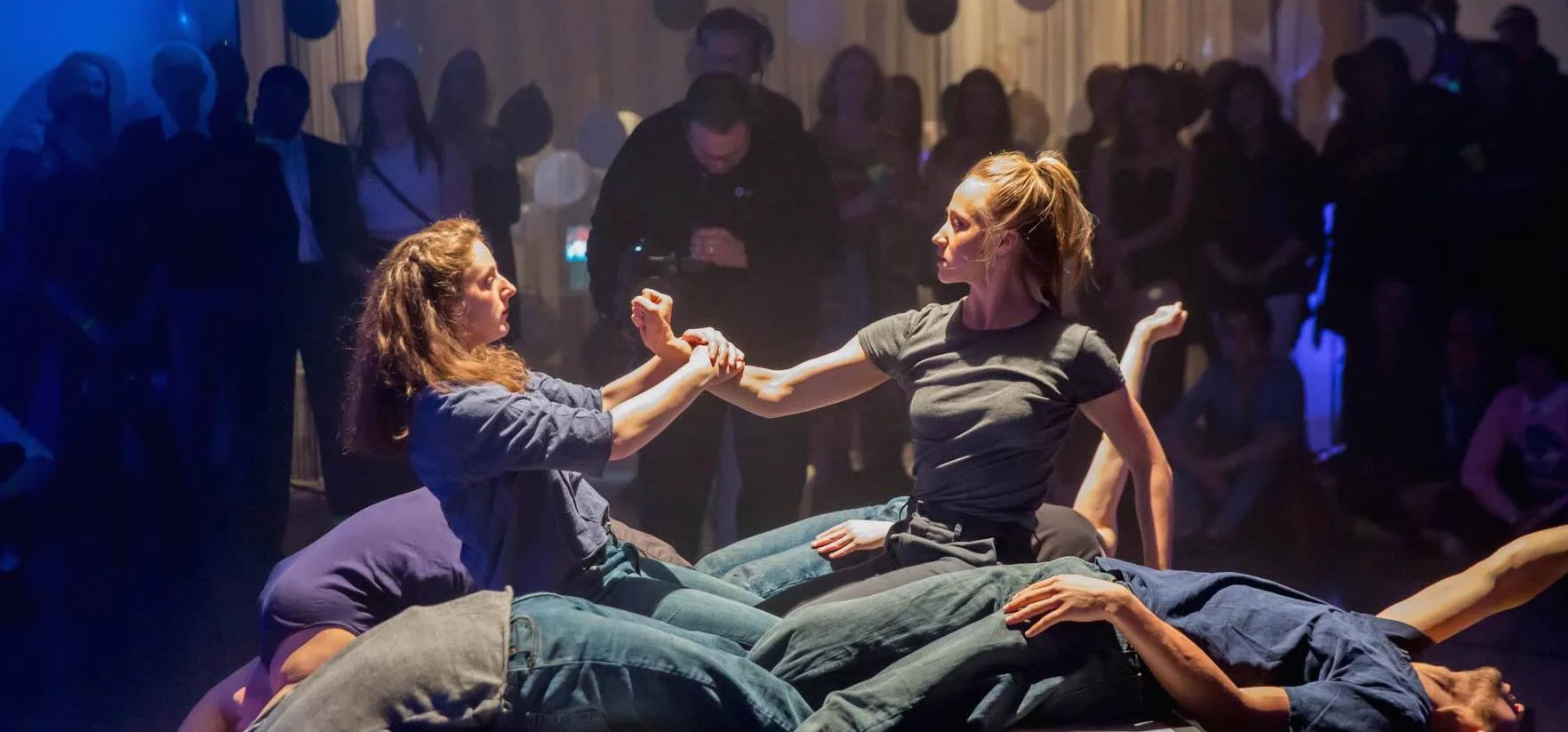
Flink “contrasts choral movement where the group becomes a single pulsating organism with solos and duets that reflect more personal turmoil. Flink danced with the Limón Dance Company and apprenticed with Paul Taylor, so it’s no surprise that his movement recalls Limón’s heroic archetypes, Doris Humprey’s communal dynamics, and Taylor’s muscular exuberance. The powerful dancers, risk-takers all, deliver the combination of buoyant athleticism and feral intensity that is a hallmark of Flink’s style. They often move in tight formation—either within shifting groupings of wooden benches that define the compartment in which they are trapped, or careening through space, colliding and rebounding off of one another. Sometimes it’s like watching a display of cascading fireworks: carefully sculpted forms filled with volatile explosions of light. Flink often confines dancers to a small area defined by the benches, compressing them like heroic working-class figures in a Diego Rivera mural. The benches become part of a fluid architecture where dancers grapple in stylized gestures of mutual support and desperate aggression. They summon up images of deck hands at work, storms at sea, a community in chaos—sometimes simultaneously.” – Linda Shapiro, February 2008.
Full Review

Minneapolis/St. Paul Star Tribune

“With Wreck, Carl Flink and his company, Black Label Movement, have created a riveting portrait of humanity on the brink, in which community is the bedrock of integrity.” – Camille LeFevre, January 14, 2008. Full review

“It’s extremely inventive choreography, infused with physical risk and kinetic surprise, riveting to watch. What makes Flink’s work compelling, however, is the caring intelligence that emanates from his movement vocabulary. These dances are human to the core. Watching them is exhilarating, emotional, moving.” – Camille LeFevre, Minneapolis/St. Paul StarTribune, August 20, 2006

“A profound emotional tenderness permeates the tough-minded physicality of Black Label Movement, which premiered its first full-length concert to a sold-out audience at the Southern Theater” -Camille LeFevre, Minneapolis/St. Paul StarTribune, August 20, 2006

“But then there are works so great that one wishes they’d never end. Only they do, at precisely the right moment, leaving you elated, shaken, breathless. They’ve been shaped, choreographed, phrased and performed with a rigor that allows for the ache of inevitability — but not before taking every muscle, tangle of emotions and welter of thoughts on a kinesthetic ride. Almost anything by Mark Morris falls into this category. So does Mathew Janczewski’s Resonance, Carl Flink’s Duet From Wreck, Uri Sands’ recent Veneers. If any of these works were a minute longer or shorter, would the experience be diminished? Hard to say. But it’s always better to leave the theater ecstatically wishing for more than having spent two hours counting every agonizing moment until you could escape. – Camille Lefevre, Minneapolis/St.Paul StarTribune, April 17, 2007.

From the StarTribune 2006 Year in Review, “This year Flink also premiered his new dance company, Black Label Movement. His inventive choreography, derived from physical risk and kinetic surprise, emanates a deep, soulful humanity.” – Camille Lefevre, Minneapolis/St.Paul StarTribune, December 26, 2006

In The Metropolitan Ballet’s premiere of it’s ballet Dracula, “Carl Flink’s visceral scene, with dancers from his Black Label Movement, was one you could really sink your teeth into. Once again, Oroyan tore weightlessly through space, extracting every drop of character from his role as if the weight of the entire show rested on his shoulders.” – Camille Lefevre, Minneapolis/St.Paul StarTribune, October 31, 2006.

St. Paul Pioneer Press

“Watching Carl Flink’s dynamic Black label Movement dancers forge their way through his magnum force pieces, you can’t help wonder why dance has not been designated as an Olympic sport. But then again, what sport could match the blend of gymnastic control and nonstop momentum of Flink’s choreography? Or its beautifully sculpted movement? Or it’s emotional wallop?” -Linda Shapiro, St. Paul Pioneer Press, August 20, 2006.

“Flink and Plauché Flink’s choreography oozes elegance, intelligence and the irrepressible vigor of artists approaching the top of their game.” -Linda Shapiro, St. Paul Pioneer Press, August 20, 2006.

“Meanwhile, Flink carefully designs the space — sometimes by personally shining a searchlight on particular dancers — imposing visual texture and sculptural clarity on their frenetic movement.” -Linda Shapiro, St. Paul Pioneer Press, August 20, 2006.

In The Metropolitan Ballet’s premiere of it’s ballet Dracula, a scene “choreographed by Carl Flink and danced with frenzied fluidity and gymnastic prowess by Oroyan and members of Flink’s Black Label Movement company, the scene sizzles with pity and terror.” Linda Shapiro, St. Paul Pioneer Press, October 29, 2006.

Howwastheshow.com

Throughout Wreck the BLM movers “move about the stage in seemingly chaotic and random ways. However, their perfect interaction and seamless movements suggest that there is some defining force at work. The force, of course, is the choreography of Carl Flink, the wunderkind behind Wreck as well as a BLM performer. His piece loosely details a stormy boat journey across the Great Lakes. While the story is nearly impossible to follow in a linear fashion, I don’t believe that it is meant to be translated literally into something easily understood. Rather, it is a collection of dreamlike sequences—some eerily cheerful, many downright nightmarish, that are all tied together with invisible strands to the idea of crossing a body of water.” Jon Behm, January 11, 2008.
Full Review